
- August 19, 2026
- Posted by: admin
- Category: Blog
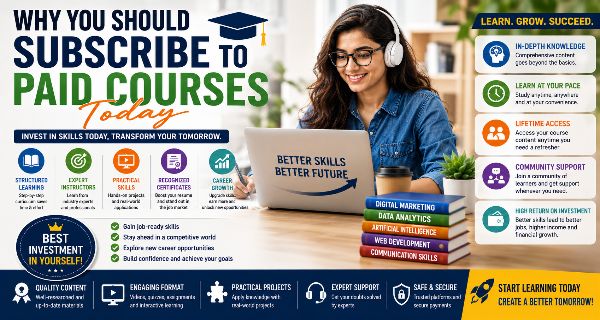
In a rapidly changing world, learning new skills is one of the best investments you can make in your career and personal development. Free educational resources are widely available online, but paid courses often provide a more structured, focused, and comprehensive learning experience.
Whether you want to learn Artificial Intelligence, digital marketing, graphic design, communication, finance, entrepreneurship, or another professional skill, a well-designed paid course can help you move from basic knowledge to practical application.
The key is to choose courses that offer genuine value, quality instruction, practical learning, and content relevant to your goals.
What Are Paid Online Courses?
Paid online courses are structured educational programs that require a one-time payment or subscription fee. They may include video lessons, assignments, downloadable resources, assessments, live sessions, projects, instructor support, and certificates.
Unlike scattered free resources, a good paid course generally provides a clear learning pathway from fundamentals to more advanced concepts.
1. Structured Learning Saves Time
One of the biggest advantages of a quality paid course is structure.
Instead of spending hours searching for:
- Tutorials
- Videos
- Articles
- Practice materials
- Different learning resources
you can follow a planned curriculum designed around a specific learning objective.
A structured approach can make learning more efficient and reduce confusion.
2. Learn from Organized and Curated Content
The internet contains an enormous amount of information, but not all of it is accurate, current, or suitable for beginners.
Paid courses can provide carefully organized content that takes learners through concepts in a logical order.
This is particularly useful when learning complex subjects such as:
- Artificial Intelligence
- Data Analytics
- Digital Marketing
- Coding
- Cybersecurity
- Business Management
3. Access Practical Learning
A strong paid course should go beyond theory.
Look for programs that include:
- Practical assignments
- Real-world examples
- Projects
- Case studies
- Exercises
- Portfolio-building activities
Practical learning helps you understand how knowledge can be applied in real situations.
4. Learn Career-Focused Skills
Many paid courses are designed around specific professional goals.
For example, learners can choose courses focused on:
- Career advancement
- Freelancing
- Entrepreneurship
- Digital marketing
- AI productivity
- Communication
- Leadership
- Technical skills
Choosing a career-focused course can help you develop skills that are directly relevant to your professional objectives.
5. Build Skills with Expert Guidance
Many paid courses are created or delivered by experienced instructors and industry professionals.
Expert guidance can help learners:
- Understand difficult concepts
- Avoid common mistakes
- Follow proven workflows
- Learn practical techniques
- Get answers to questions
However, always research the instructor’s qualifications and experience before purchasing a course.
6. Stay Motivated to Complete Your Learning
When you invest in a course, you may feel more committed to completing it.
A structured program with lessons, assignments, progress tracking, and deadlines can create accountability.
The value comes not simply from paying for the course but from actually completing the learning and applying the skills.
7. Learn at Your Own Pace
Many paid online courses provide flexible access, allowing learners to study according to their schedules.
You can often:
- Watch lessons after work
- Study during weekends
- Pause and replay lessons
- Review difficult topics
- Learn from home
- Access lessons using a computer or mobile device
This flexibility is particularly useful for working professionals and students.
8. Build a Professional Portfolio
Courses that include practical projects can help you build evidence of your abilities.
For example:
A digital marketing learner can create a sample campaign.
A graphic design learner can develop branding projects.
A web development learner can build websites.
A data analytics learner can create dashboards.
A portfolio can demonstrate practical ability to employers or clients.
9. Earn Certificates
Many paid courses offer certificates after successful completion.
Certificates can be added to:
- Resumes
- LinkedIn profiles
- Professional portfolios
- Job applications
However, a certificate is most useful when it represents genuine learning and is supported by practical skills and experience.
10. Upgrade Your Skills Without Leaving Your Job
Traditional education may require significant time commitments. Online paid courses can provide another option for professionals who want to continue working while learning.
You can gradually develop new skills without necessarily taking a career break.
This makes online learning particularly useful for upskilling and reskilling.
11. Explore New Career Opportunities
Learning a new skill can introduce you to career paths you may not have previously considered.
For example, someone with a background in administration could explore:
- Digital marketing
- Data analytics
- Project management
- AI productivity
- Business communication
Similarly, a creative professional could explore video editing, graphic design, content creation, or digital branding.
12. Support Freelancing and Entrepreneurship
Paid courses can also help aspiring freelancers and entrepreneurs develop practical business skills.
Useful areas include:
- Client management
- Digital marketing
- Sales
- Branding
- Financial management
- Social media
- Website development
- Business planning
Combining professional expertise with business skills can create new income opportunities.
13. Keep Up with Technology
Technology changes continuously. New AI tools, digital platforms, software, and business practices are introduced regularly.
Paid courses can provide a structured way to learn emerging technologies rather than relying only on random online information.
Courses focused on AI, digital transformation, cybersecurity, data, and automation can be particularly useful for professionals whose industries are rapidly changing.
How to Choose the Right Paid Course
Not every paid course is worth the investment. Before subscribing, consider:
Check the Curriculum
Make sure the course covers the skills you actually want to learn.
Research the Instructor
Look at the instructor’s experience, qualifications, and professional background.
Look for Practical Projects
Courses with hands-on assignments can provide more value than programs based only on video lectures.
Check Reviews Carefully
Read learner feedback, but don’t rely on ratings alone. Look for detailed reviews discussing course quality and outcomes.
Consider Course Updates
Technology-focused subjects can become outdated quickly. Check whether the course content is regularly updated.
Evaluate Support
Instructor interaction, community support, discussion forums, or feedback can make the learning experience more effective.
Compare the Cost With the Value
Consider whether the skills you will gain justify the price. A higher price does not automatically mean higher quality.
Paid vs Free Courses
Free resources can be excellent for exploring a subject or learning basic concepts. Paid courses may be more useful when you want a structured curriculum, practical projects, instructor guidance, or a complete learning pathway.
The best choice depends on your goals, budget, learning style, and the quality of the specific course.
Make the Most of Your Paid Course
Once you subscribe, don’t simply collect another certificate.
Follow these habits:
- Create a weekly learning schedule.
- Complete lessons consistently.
- Take notes.
- Finish assignments.
- Build practical projects.
- Ask questions when you need help.
- Add useful projects to your portfolio.
- Apply your new skills to real-world situations.
Learning creates value when knowledge is converted into action.
Conclusion
Subscribing to a paid course can be a smart investment when the course offers quality content, practical learning, expert guidance, and skills that align with your goals. It can help you learn more systematically, develop job-ready capabilities, build a portfolio, and prepare for new professional opportunities.
However, the decision should not be based simply on the fact that a course is paid. Research the curriculum, instructor, reviews, practical components, updates, and overall value before making a purchase.