- August 13, 2026
- Posted by: admin
- Category: Blog
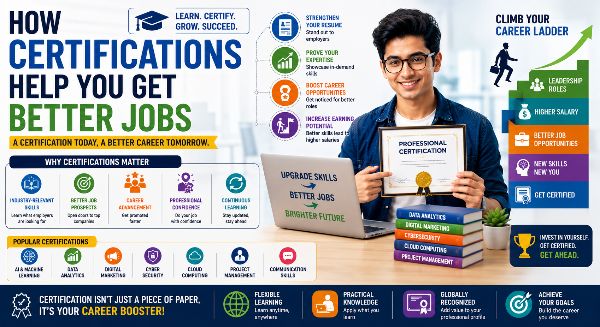
In today’s competitive job market, having a degree is often only the beginning of a successful career. Employers increasingly look for candidates who can demonstrate practical knowledge, specialized expertise, and a commitment to continuous learning. This is where professional certifications can make a meaningful difference.
Certifications provide structured learning in specific areas and can help candidates demonstrate their skills to potential employers. Whether you are starting your career, looking for a promotion, changing industries, or returning to work after a career break, the right certification can strengthen your professional profile.
What Is a Professional Certification?
A professional certification is a credential awarded after completing a course, training program, assessment, or examination that demonstrates knowledge in a particular field.
Certifications can cover areas such as:
- Artificial Intelligence
- Digital Marketing
- Data Analytics
- Cybersecurity
- Project Management
- Financial Literacy
- Cloud Computing
- Communication
- Human Resources
- Entrepreneurship
The value of a certification depends on the quality of the training, the relevance of the skill, and how well it matches industry requirements.
Why Certifications Matter in the Job Market
Employers often receive applications from candidates with similar educational backgrounds. A relevant certification can help distinguish your profile by demonstrating that you have taken additional steps to develop specialized knowledge.
Certifications can show:
- Commitment to professional development
- Interest in a particular field
- Knowledge of industry tools and practices
- Willingness to learn
- Readiness to take on new responsibilities
When combined with education and practical experience, certifications can strengthen your overall career profile.
1. Certifications Can Strengthen Your Resume
A well-chosen certification can make your resume more relevant to a particular job.
For example, someone applying for a digital marketing position may benefit from certifications related to:
- SEO
- Google Ads
- Social media marketing
- Content marketing
- Analytics
Including relevant credentials can help recruiters quickly identify your areas of expertise.
2. They Help Demonstrate Specialized Skills
A degree may provide broad knowledge, while a certification can focus on a specific professional skill.
For example, a professional could complement a general business qualification with certifications in:
- Data analytics
- Project management
- Digital marketing
- AI productivity tools
- Financial management
This combination can create a more targeted professional profile.
3. Certifications Support Career Changes
Changing careers can be challenging because employers may question whether a candidate has the necessary knowledge for a new field.
A relevant certification can help bridge that gap.
For example, someone moving into digital marketing could learn:
- SEO
- Social media management
- Digital advertising
- Web analytics
- Content strategy
A certification combined with practical projects can demonstrate a serious commitment to the new career path.
4. They Can Help With Career Advancement
Certifications aren’t only useful for job seekers. Existing employees can use them to prepare for greater responsibilities.
Additional training can help professionals qualify for:
- Promotions
- Specialized roles
- Leadership positions
- New projects
- Higher-level responsibilities
Upskilling demonstrates initiative and a willingness to grow within an organization.
5. Certifications Encourage Continuous Learning
Industries change constantly. New technologies, tools, regulations, and business practices can make existing knowledge outdated.
Professional certifications encourage individuals to continue learning and updating their expertise.
Lifelong learning can help professionals remain adaptable and prepared for future opportunities.
6. They Can Improve Professional Confidence
Learning a new skill and successfully completing a structured course can increase confidence.
Professionals may feel better prepared to:
- Participate in workplace discussions
- Use new technologies
- Handle specialized tasks
- Take on projects
- Apply for new positions
Confidence combined with practical knowledge can have a positive impact on career development.
7. Online Certifications Make Learning Accessible
Online education has made professional development easier and more flexible.
Learners can often complete courses:
- From home
- After work
- During weekends
- At their own pace
- Using a smartphone or computer
This makes certification programs particularly useful for working professionals who cannot attend traditional classroom programs.
8. Certifications Can Complement Practical Experience
A certification alone does not guarantee employment. Employers also value the ability to apply knowledge in real-world situations.
For this reason, learners should combine certification programs with:
- Practical projects
- Internships
- Freelance assignments
- Portfolio development
- Workplace experience
For example, someone completing a graphic design certification can create sample logos, social media graphics, presentations, and branding projects to demonstrate practical ability.
9. Certifications Can Improve Your Professional Profile
Professional certifications can be included on:
- Resumes
- LinkedIn profiles
- Professional portfolios
- Job applications
- Business profiles
A strong professional profile combines education, certifications, practical experience, projects, and measurable achievements.
10. Choose Certifications Carefully
Not every certification has the same value. Before enrolling, consider:
Industry Relevance
Choose a certification that teaches skills currently used or increasingly required in your target industry.
Course Quality
Review the curriculum, instructor experience, practical assignments, and learning resources.
Recognition
Consider whether the certification is respected by employers or relevant professional communities.
Practical Learning
Courses that include projects and real-world applications can provide more value than programs based entirely on theory.
Career Goals
Choose certifications that support the specific job or career path you want to pursue.
Certifications for Different Career Stages
Students
Students can use certifications to gain practical skills before entering the workforce.
Useful areas include:
- Digital literacy
- AI fundamentals
- Communication
- Digital marketing
- Data analysis
- Coding
Fresh Graduates
Graduates can use certifications to specialize in areas that complement their academic qualifications.
Working Professionals
Professionals can use certifications to upgrade their existing skills, prepare for promotions, or move into new roles.
Entrepreneurs
Business owners can develop skills in marketing, finance, technology, leadership, and business management.
How to Get the Most From a Certification
Simply earning a certificate is not enough. Make the learning useful by applying it.
A good approach is:
Learn → Practice → Build → Showcase → Apply
Learn the concepts, practice them through projects, build a portfolio, showcase your work, and apply for opportunities where those skills are relevant.
Certifications and the Future of Work
As technology continues to transform the workplace, specialized skills will remain increasingly important. Fields such as Artificial Intelligence, cybersecurity, data analytics, cloud computing, digital marketing, and automation are creating demand for professionals who continuously upgrade their knowledge.
Certifications can provide a structured pathway for learning these skills and demonstrating your commitment to professional development.
Conclusion
Professional certifications can be valuable tools for building a stronger career profile. They can demonstrate specialized knowledge, support career changes, strengthen resumes, improve confidence, and prepare professionals for new responsibilities.
However, the most effective approach is to combine certification with practical experience, strong communication, problem-solving abilities, and continuous learning.
Choose certifications based on your career goals and industry requirements, apply what you learn, and build evidence of your skills through real-world projects.
The right certification may not guarantee a better job, but it can help you demonstrate that you are prepared for better opportunities.