
- April 25, 2026
- Posted by: admin
- Category: Blog
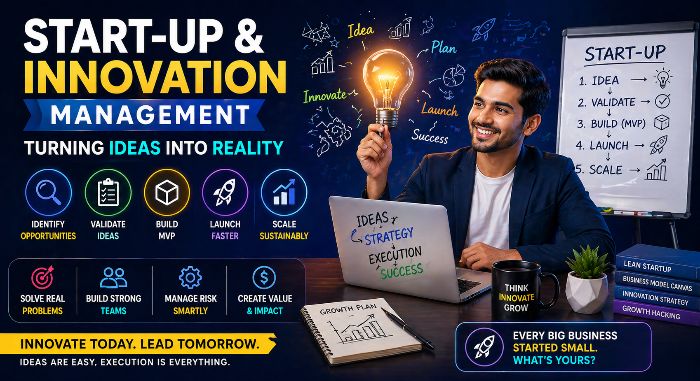
In today’s fast-changing business landscape, ideas alone are not enough—execution is everything. Start-ups are built on innovative ideas, but their success depends on how effectively those ideas are managed, developed, and scaled. Start-up and innovation management provides a structured approach to transforming concepts into successful businesses by combining creativity, strategy, and execution.
Understanding Start-up and Innovation Management
Start-up management focuses on building and growing a new business, while innovation management ensures that fresh ideas are continuously developed and implemented. Together, they create a framework that helps entrepreneurs move from concept to market-ready solutions.
This process involves identifying opportunities, validating ideas, developing products or services, and scaling operations. It requires a balance between creativity and business discipline.
From Idea to Validation
Every successful start-up begins with an idea, but not every idea turns into a viable business. The first step is validation—testing whether the idea solves a real problem and has market demand.
Entrepreneurs conduct market research, gather feedback, and analyze competitors to refine their concepts. This stage reduces risks and ensures that resources are invested in ideas with real potential.
Building a Strong Business Model
A well-defined business model is essential for start-up success. It outlines how the business will create value, generate revenue, and sustain operations.
Innovation management helps in designing flexible business models that can adapt to changing market conditions. This includes identifying target customers, pricing strategies, and distribution channels.
Developing a Minimum Viable Product (MVP)
Instead of launching a fully developed product, start-ups often begin with a Minimum Viable Product. An MVP is a basic version of the product that includes core features required to solve the problem.
This approach allows entrepreneurs to test their product in real-world conditions, gather user feedback, and make improvements before scaling. It saves time, reduces costs, and increases the chances of success.
Leveraging Technology and Innovation
Technology plays a crucial role in modern start-ups. From artificial intelligence and data analytics to automation and digital platforms, innovation enables businesses to operate efficiently and scale quickly.
Start-ups that adopt new technologies can gain a competitive advantage by offering better solutions, improving customer experiences, and optimizing operations.
Managing Risks and Challenges
Start-ups face numerous challenges, including financial constraints, market competition, and operational uncertainties. Effective innovation management helps in identifying risks early and developing strategies to overcome them.
Agility and adaptability are key traits for start-up success. Entrepreneurs must be prepared to pivot their strategies based on market feedback and changing conditions.
Building a Strong Team
A successful start-up is built on a strong and motivated team. Hiring the right talent, fostering collaboration, and creating a positive work culture are essential for innovation.
Teams that encourage creativity and open communication are more likely to generate new ideas and solve problems effectively.
Scaling and Growth Strategies
Once a start-up gains traction, the focus shifts to scaling. This involves expanding operations, increasing customer base, and improving revenue streams.
Innovation management ensures that growth is sustainable by optimizing processes, maintaining quality, and adapting to market demands. Strategic partnerships and funding opportunities also play a significant role in scaling.
The Future of Start-ups and Innovation
The start-up ecosystem is evolving rapidly, with new opportunities emerging across industries. Innovation will continue to be the driving force behind successful businesses.
Entrepreneurs who embrace structured management practices, leverage technology, and focus on continuous improvement will be better positioned to turn their ideas into reality.
Start-up and innovation management is not just about launching a business—it is about building something valuable, sustainable, and impactful. With the right approach, any idea has the potential to become a successful venture.