- March 30, 2026
- Posted by: Sarthi Skill Your Identity
- Category: Blog
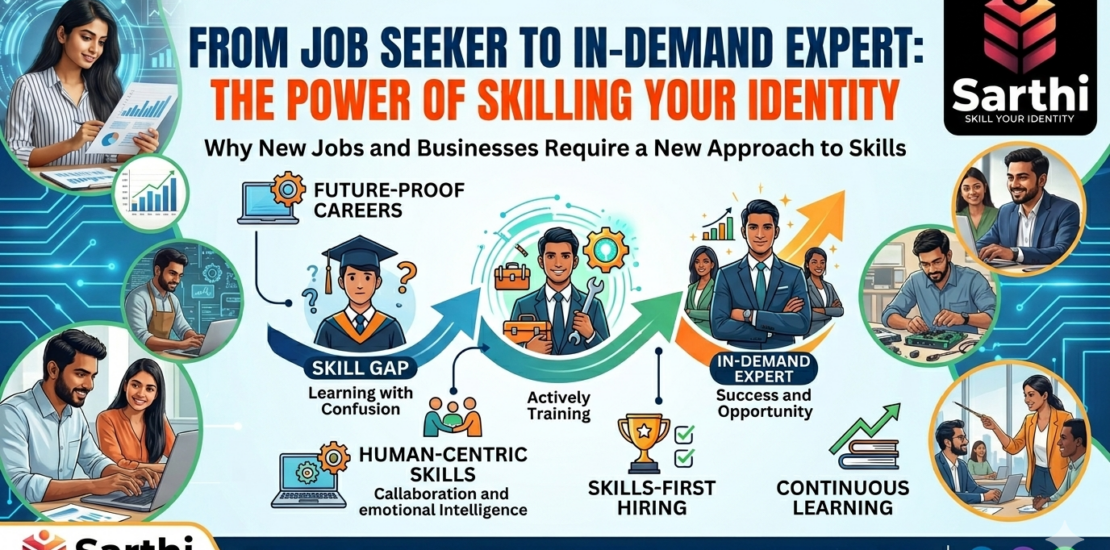
Whether you are a fresh graduate, a small business owner in a quiet town, or an experienced worker looking for a change, the world of work in 2026 feels very different. At SARTHI – Skill Your Identity, we believe that your “Identity” isn’t just your name or your degree—it’s the unique set of skills you bring to the table.
But why has “skilling” suddenly become the most important word in the modern economy? Why can’t we just rely on what we learned in school?
Here is why new jobs and modern businesses require a completely new approach to skills.
1. The “Half-Life” of Knowledge is Shrinking
In the past, a person could learn a trade and practice it for 40 years until retirement. Today, the “half-life” of a professional skill is estimated to be only about five years. This means that half of what you know today might be obsolete by 2031.
For Workers: If you don’t upskill, your value in the job market decreases every year.
For Businesses: Companies that don’t train their staff on new tools (like AI or digital logistics) quickly lose their competitive edge.
2. Technology is No Longer “Optional”
Whether you are a farmer, a shopkeeper, or an engineer, technology is now the “infrastructure” of your work.
The Rural Shift: In rural India, we are seeing tailors using WhatsApp for business, farmers using drones for soil analysis, and mechanics repairing electric vehicles (EVs).
The “AI-Adjacent” Worker: You don’t need to be a computer scientist, but you do need to be “AI-literate”—knowing how to use digital tools to do your job faster and better.
3. From “Degree-First” to “Skills-First” Hiring
Major global employers and local startups alike are moving toward Skills-Based Hiring. In 2026, many companies care less about where you went to college and more about what you can actually do.
+1
Micro-credentials: Short, specialized certifications (like those offered by SARTHI) are often more valuable to an employer than a three-year general degree because they prove you have “job-ready” expertise in a specific area, like industrial electronics or digital marketing.
4. The Rise of “Human-Centric” Skills
As machines take over repetitive tasks (like data entry or basic assembly), the jobs that remain require “Human Skills” that AI cannot replicate. Modern businesses are desperate for people who excel in:
Critical Thinking: Solving problems when there is no “manual.”
Emotional Intelligence: Managing teams and understanding customer needs.
Adaptability: The “skill of learning” itself—being a “rookie” over and over as the world changes.
What does this mean for YOU?
At SARTHI – Skill Your Identity, we don’t just teach you how to operate a machine or code a page; we help you build a future-proof identity.
New jobs aren’t “disappearing”—they are evolving. By bridging the gap between traditional education and industry demands, we empower you to not just find a job, but to become an essential part of the modern economy.
“The future belongs to those who learn more skills, more often.”
Ready to redefine your identity?
Explore our industry-aligned courses in electronics, machinery, and digital literacy.